Opiate overdose, whether caused by prescription drugs or illicit opiates, can be fatal. Fortunately, naloxone, an opiate antagonist, can reverse the overdose effects, often saving a person’s life.
What Happens During Opiate Overdose?
Overdose is a very common outcome of opiate addiction. It is also common for many recovering addicts to relapse and take the same amount of the drug that they were taking before. At this point, the body has gone through detox and cannot handle the high doses of opiates. This often leads to overdose and death. The NLM states that “if a user becomes dependent [on opiates], then they are between 6 and 20 times more likely to die than someone in the general population.” The NLM states the symptoms you should look for when someone is undergoing heroin overdose. These symptoms are common among all types of opiate overdose.
- Shallow, weak, or no breathing
- Weak pulse
- “Tongue discoloration”
- “Pinpoint pupils” or very small pupils
- Cyanosis or “bluish-colored nails and lips”
- Constipation
- Low blood pressure
- Stomach spasms
- Drowsiness
- Disorientation
These symptoms can lead to worse symptoms such as:
- Respiratory depression
- Coma
- Delirium
- Death
How Naloxone Works
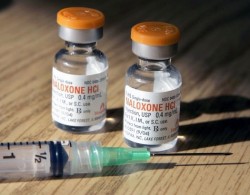
Naloxone is usually administered through injection.
According to the NLM, naloxone “works by blocking the overdose effects to relieve dangerous symptoms caused by high levels of opiates in the blood.” It is usually injected intravenously. It attaches to the same parts of the brain that opiates do, and it blocks their effects for up to an hour and a half. This is incredibly important when a person has undergone respiratory depression as a symptom of overdose. Naloxone allows the person to breathe and wakes them from the opiate-induced stupor long enough for the most dangerous side effects of the overdose to pass. Naloxone is often used in addition to other treatments when a person is first brought to a hospital for heroin or other opiate-based overdose. However, in a dire emergency, it can also be used by someone who is not a medical professional.
Using Naloxone
Naloxone, brand name Narcan, can be bought as a solution or as a pre-filled auto-injection device. If you know a person who is abusing opiates and you are concerned about a possibility for overdose, it is important to carry naloxone. “You will probably be unable to treat yourself if you experience an opiate overdose” (NLM). This is why it is important to have a friend or loved one who can perform the injection for you. Here are some tips on performing a naloxone injection with a pre-filled auto-injection device (Evzio):
- As soon as you believe someone has overdosed, call 911.
- After calling 911, inject the medication “into the muscle or under the skin of [the person’s] thigh.”
- You can inject naloxone through the person’s clothing if necessary.
- Stay with the person and wait for help to arrive.
- If symptoms return, give the person another injection of naloxone with an unused auto-injection device.
Naloxone injection saves lives. Make sure you know how to use the injection device if you suspect someone close to you of being at risk for opiate overdose.
 What are the Stages of Opiate Withdrawal? -
Opiates are those drugs including opium, opium derivatives, and the semi-synthetic or synthetic substitutes with similar chemical structures. The most common opiates are fentanyl, methadone, morphine, codeine, oxycodone, hydrocodone, and the illegal drug, heroin. No matter which opiate drug you use, repeated use can lead to dependency and subsequently, withdrawals upon ceasing. The stages of ...
What are the Stages of Opiate Withdrawal? -
Opiates are those drugs including opium, opium derivatives, and the semi-synthetic or synthetic substitutes with similar chemical structures. The most common opiates are fentanyl, methadone, morphine, codeine, oxycodone, hydrocodone, and the illegal drug, heroin. No matter which opiate drug you use, repeated use can lead to dependency and subsequently, withdrawals upon ceasing. The stages of ...  Opiate Withdrawal Timeline of Symptoms -
The DEA states, “Physical dependence is a consequence of chronic opioid use, and withdrawal takes place when drug use is discontinued.” When people suddenly stop abusing prescription opiates, heroin, and other types of narcotics, they will encounter a number of symptoms that usually fall into a specific pattern and timeline. Overall, most opiate withdrawal syndromes ...
Opiate Withdrawal Timeline of Symptoms -
The DEA states, “Physical dependence is a consequence of chronic opioid use, and withdrawal takes place when drug use is discontinued.” When people suddenly stop abusing prescription opiates, heroin, and other types of narcotics, they will encounter a number of symptoms that usually fall into a specific pattern and timeline. Overall, most opiate withdrawal syndromes ...  Am I a Good Candidate for Naltrexone? -
Naltrexone can be a beneficial treatment option for many recovering opiate addicts, however it is not meant for everyone.
Am I a Good Candidate for Naltrexone? -
Naltrexone can be a beneficial treatment option for many recovering opiate addicts, however it is not meant for everyone.  15 Dangers of Opiates You Need to Be Aware Of -
1. Respiratory Depression According to the NIDA, “Taken as prescribed, opioids can be used to manage pain safely and effectively. However, when abused, even a single large dose can cause severe respiratory depression and death.” All opioids have the potential to cause breathing to slow dangerously (and even stop) when taken in high doses. This ...
15 Dangers of Opiates You Need to Be Aware Of -
1. Respiratory Depression According to the NIDA, “Taken as prescribed, opioids can be used to manage pain safely and effectively. However, when abused, even a single large dose can cause severe respiratory depression and death.” All opioids have the potential to cause breathing to slow dangerously (and even stop) when taken in high doses. This ...  On Opium Addiction & Why ‘Knowing Your Limits’ is Not Enough -
While opium, per se, has a long history of recreational use dating as far back as the 1960s, many of today’s most addictive substances use opium-derived substances as main ingredients. Heroin and prescription pain medications lead the pack as the most commonly abused opium-based substances in existence. Opium drugs rank number one in terms of ...
On Opium Addiction & Why ‘Knowing Your Limits’ is Not Enough -
While opium, per se, has a long history of recreational use dating as far back as the 1960s, many of today’s most addictive substances use opium-derived substances as main ingredients. Heroin and prescription pain medications lead the pack as the most commonly abused opium-based substances in existence. Opium drugs rank number one in terms of ...