Through ongoing research and development, the opium poppy plant has spawned an entire family of drugs, commonly known as opiates. The majority of opiates produce pain-relieving effects, though there are a handful that produce different types of effects.
According to Palomar College, the opium poppy contains several alkaloids, or organic compounds that can interact with the human body and alter more than a few of its essential chemical processes. The list of opiates derived from the opium poppy can be broken up into different drug classifications based on each drug’s relation to the opium poppy plant.
For information on opiate addiction treatment programs, call our toll-free helpline at 877-743-0081 (Who Answers?).
Opiate Drug Classifications
As a group, opiates interact with the body’s own pain-management system, which is made up of various neurotransmitter and endorphin chemicals. In turn, opiate or opioid receptor sites exist throughout the brain, spinal cord, digestive tract as well as in other organs throughout the body, according to the National Institute on Drug Abuse.
This list of opiates starts with the natural opium poppy alkaloids and then progresses into the man-made or synthetic varieties.
Natural Opium Derivatives
Natural opium-based drugs are derived from the alkaloid compounds found in the opium poppy plant. Natural derivatives include the following:
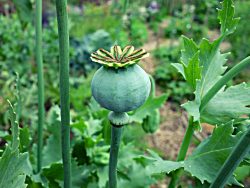
Natural opiates are derived from the opium poppy plant.
- Morphine
- Codeine
- Heroin
- Thebaine
- Oripavine
Morphine and heroin in particular exist as the two strongest natural opium derivatives. Morphine-based alkaloids appear in large concentrations within the opium poppy, whereas as heroin comes from specific types of opium poppy plants, such as the Asian poppy.
Semisynthetic Opium Derivatives
Semisynthetic opium derivatives contain both natural and synthetic, or man-made ingredients. This opiate classification contains a few of the more powerful prescription opiate drugs on the market.
Some of the more commonly used semisynthetic opiates include:
- Oxymorphone
- Oxycodone
- Hydromorphone
- Hydrocodone
- Buprenorphine
Since these drugs contain a mixture of natural and man-made ingredients, they can vary in potency levels based on any one drug’s synthetic chemical makeup.
Synthetic Opium Derivatives
Synthetic opium derivatives contain all man-made ingredients, with this classification including some of the most powerful prescription opiate drugs in existence. As opiates carry a high risk for abuse and addiction, the more powerful the drug the greater the risk, according to the Journal of Drug & Alcohol Dependence.
Some of the more well-known synthetic opiates include:
- Fentanyl
- Lortab
- Demerol
- Methadone
- Dilaudid
- Norco
- Atarax
Opiate Addiction Treatment Medications
This list of opiates contains a few choice drugs that have been specifically designed to treat opiate addiction. Both buprenorphine and methadone produce effects that work to stabilize chemical imbalances in the brain left behind by chronic opiate addiction.
Yet another classification to add to the list of opiates are the antagonist drugs. Naltrexone and naloxone, two drugs that work as opiate addiction preventative agents, produce uncomfortable effects in the event a person relapses in recovery.
Considerations
While this list of opiates is by no means exhaustive, it does cover the main categories for this group of drugs. It helps to keep in mind that regardless of whether a person uses opiates for treatment purposes or on a recreational basis, the abuse and addiction potential for opiates remains the same.
Please don’t hesitate to call our helpline at 877-743-0081 (Who Answers?) if you need help finding an opiate addiction treatment program.
 What Drugs are Opiates? -
Most all opiates are modeled after opium, nature’s natural pain-relieving agent. According to the Institute for Substance Abuse Treatment Evaluation, some opiates come directly from the opium plant while others exist as synthetically-made agents that produce similar effects. While the question “what drugs are opiates” may seem to be fairly straight-forward, this drug class includes ...
What Drugs are Opiates? -
Most all opiates are modeled after opium, nature’s natural pain-relieving agent. According to the Institute for Substance Abuse Treatment Evaluation, some opiates come directly from the opium plant while others exist as synthetically-made agents that produce similar effects. While the question “what drugs are opiates” may seem to be fairly straight-forward, this drug class includes ...  Choosing the Best Inpatient Hydrocodone Withdrawal Treatment -
Prescription Hydrocodone abuse has reached epidemic proportions in the United States. Although many people use this prescription drug as directed, it is still possible to become addicted to it. Hydrocodone addiction is an opiate addiction just like heroin or any of the other opium based medications. Although the symptoms of opiate withdrawal are not deadly, they ...
Choosing the Best Inpatient Hydrocodone Withdrawal Treatment -
Prescription Hydrocodone abuse has reached epidemic proportions in the United States. Although many people use this prescription drug as directed, it is still possible to become addicted to it. Hydrocodone addiction is an opiate addiction just like heroin or any of the other opium based medications. Although the symptoms of opiate withdrawal are not deadly, they ...  Types of Help for Opium Addiction -
If you are seeking treatment for opium addiction for yourself or someone else, then learning about the options available for treatment can help you decide which is best, especially if you are feeling confused, and have questions. Discussing the treatment options with a professional is highly recommended. Addiction to opium can become so severe to the point ...
Types of Help for Opium Addiction -
If you are seeking treatment for opium addiction for yourself or someone else, then learning about the options available for treatment can help you decide which is best, especially if you are feeling confused, and have questions. Discussing the treatment options with a professional is highly recommended. Addiction to opium can become so severe to the point ...  20 Symptoms of Opioid Withdrawal Commonly Experienced -
Symptoms of opioid withdrawal begin within hours of the last opioid dose depending on the type and potency of the drug, how it was used, individual biological factors, and the tolerance and dependency developments. According to the National Institute on Drug Abuse, “Dependence develops when the neurons adapt to the repeated drug exposure and only ...
20 Symptoms of Opioid Withdrawal Commonly Experienced -
Symptoms of opioid withdrawal begin within hours of the last opioid dose depending on the type and potency of the drug, how it was used, individual biological factors, and the tolerance and dependency developments. According to the National Institute on Drug Abuse, “Dependence develops when the neurons adapt to the repeated drug exposure and only ...  Tips for Choosing the Right Opium Addiction Treatment Center for You -
When you decide to attend opium addiction treatment, you should take certain steps to ensure that the treatment center you choose is the right one. According to the NIDA, “no single treatment is appropriate for everyone.” Here are some tips for choosing the right opium addiction treatment center for you. Choosing Between Outpatient Treatment and ...
Tips for Choosing the Right Opium Addiction Treatment Center for You -
When you decide to attend opium addiction treatment, you should take certain steps to ensure that the treatment center you choose is the right one. According to the NIDA, “no single treatment is appropriate for everyone.” Here are some tips for choosing the right opium addiction treatment center for you. Choosing Between Outpatient Treatment and ...