Synthetic opioids, according to ISATE, are narcotic analgesic drugs that are “manufactured in chemical laboratories with a similar chemical structure” to natural opiate drugs. These substances can be illicit drugs or medications that are legally prescribed by doctors to treat patients with mild to severe pain issues. They have many of the same qualities that opiates do, despite being manmade.
Which Opioids are Synthetic?
There are actually a large amount of opioids that are either synthetic or semi-synthetic (meaning that they are synthesized from naturally-occurring opiates). These drugs are used and abused in many different ways and can be both beneficial and dangerous to users, even deadly if taken in high enough doses.
The common synthetic and semi-synthetic opioids are:
- Synthetic opioids
- Meperidine
- Commonly known as by its brand name Demerol, meperidine is used to “relieve moderate to severe pain” (NLM).
- Fentanyl
- Fentanyl is a particularly potent synthetic opioid that should only be used by those individuals who are already tolerant to narcotics.
- Methadone
- Methadone was produced in the 1930s by “a team of German scientists [who were] searching for a pain-killing drug (analgesic) that would not be as addictive as morphine” (CESAR).
- Despite the fact that methadone is often used to treat opioid addiction, it can still be addictive itself when not used correctly which is why it is abused by many individuals.
- Meperidine
- Semi-synthetic opioids
- Buprenorphine
- Buprenorphine is a semi-synthetic opioid. It is derived from thebaine, which is a natural opiate that occurs in the poppy plant.
- Although buprenorphine is technically considered an opioid, it is only a partial opioid agonist, meaning that “its maximal effects are less than those of full agonists like heroin and methadone” (SAMHSA). This is why it is used to treat individuals who become addicted to opioids.
- Hydromorphone
- Hydromorphone is most commonly referred to as Dilaudid, one of its brand names. When abusers discuss it, it is often called dust or footballs. It is derived from morphine.
- Oxymorphone
- Sometimes octagonal in shape, this is where oxymorphone gets its most common street name.
- Hydrocodone
- Hydrocodone, prescribed most often as Vicodin (also containing acetaminophen), is the most “frequently prescribed opioid in the United States,” according to the DEA. It is also involved in more abuse and diversion than any other opioid drug, illicit or licit. It is synthesized from codeine which occurs in the poppy plant naturally like thebaine, morphine, and opium.
- Oxycodone
- Perhaps the most recognizable prescription opioid, oxycodone is manufactured by modifying thebaine. It is often called Oxycotton, oxy, or Perc (short for Percocet which contains oxycodone and acetaminophen).
- Heroin
- According to CESAR, “Heroin was synthesized from morphine in 1874 by the pharmaceutical company Bayer and was touted as a safer, non-addictive form of morphine.” Today, we know heroin to be one of the most addictive and dangerous illicit drugs in existence.
- Buprenorphine
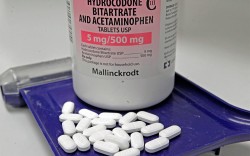
Hydrocodone is an example of a synthetic opioid.
Synthetic and semi-synthetic opioids can be both beneficial and dangerous, both licit and illicit. These drugs were all manufactured for a reason, usually to create a better, less addictive, or safer painkiller than those which already existed.
How are Synthetic Opioids Made?
Synthetic opioids are created in chemical laboratories, usually by pharmaceutical companies. They either start with a substance that occurs in the poppy plant to make a semi-synthetic opioid or manufacture the entire drug themselves. Pharmaceutical companies are always trying to create better, quicker-acting, or longer-acting drugs. This is why they create synthetic opioids.
How Should Synthetic Opioids Be Used?
Synthetic opioids should only be used under the instruction of a doctor. All opioids are scheduled by the DEA in order to prevent abuse as much as possible. The only individuals who should take opioids are those who have been prescribed them and, even in that case, patients must never deviate from the specific prescription of their doctors. Any time a user takes synthetic opioids in a way not prescribed by a doctor, that user is abusing them.
Also the way synthetic narcotics are manufactured should not be altered by the users of the drugs, as it could become problematic. According to the Massachusetts Dept. of Public Health, “Tampering with how an opioid medication is manufactured can turn a long-acting, less potent medication, into a more potent, rapid acting one.” Unfortunately, many drug abusers break apart synthetic drug tablets and crush them in order to snort them, making them much more dangerous.
Are Synthetic Opioids Deadly?
These drugs can be deadly when abused, especially in high doses. Even completely synthetic opioids can still cause the respiratory depression that is the reason for most narcotic overdose deaths. When they are used by prescription as a treatment for pain patients, these drugs are not as dangerous, but abusing them can cause many problems to occur. When taken with other substances that slow down body and brain functions, like alcohol, synthetic opioids are even more likely to cause a deadly overdose.
Are Synthetic Opioids Addictive?
When abused, yes, these drugs are addictive. According to ISATE, “Opioids relieve stress and discomfort by creating a relaxed detachment from pain, desires, and activity.” Someone who abuses them often will come to crave these feelings and might begin to display the signs of addiction, including:
- A diminished interest in activities formerly important to them
- A change in relationships
- Work, family, legal, and financial problems stemming from the opioid abuse
- Depression and other possible mental disorders
- A desire to obtain more opioids above all else and the willingness to put oneself or others in danger in order to do so
Synthetic opioids are just as addictive as natural opioids when abused, and this issue has not been solved by the derivation or synthesizing of any one opioid drug, although there is work being done to create safer opioids. Stanford University states that its bioengineers are close to “brewing painkillers” from yeast instead of poppy plants, but it is unknown whether these drugs might be safer or less addictive.
Synthetic opioids can be used safely if patients follow their doctors orders, but these drugs can be extremely dangerous when abused. Although they do not occur in nature, synthetic opioids act similarly to organic opiate drugs, causing all the same effects depending on how they are used.
 Dangers of Smoking Opiates -
Most people that use opiates do so because of the pain relieving effect it has, and the euphoric feelings they experience. Like many other drugs, opiates can cause physical and psychological problems for the user when the drug is abused. Smoking opiates can last several hours, and can be very addictive. Users feel the effects ...
Dangers of Smoking Opiates -
Most people that use opiates do so because of the pain relieving effect it has, and the euphoric feelings they experience. Like many other drugs, opiates can cause physical and psychological problems for the user when the drug is abused. Smoking opiates can last several hours, and can be very addictive. Users feel the effects ...  6 Ways Your Loved One Could be Hiding Opiate Addiction Right in Front of You -
According to the Centers for Disease Control, prescription drug addiction is reaching epidemic proportions. Due to its nature, people tend to hide their addictions to continue using without being caught. There are a lot of ways that people use to hide their opiate abuse. Using Family as an Excuse When a user is late for ...
6 Ways Your Loved One Could be Hiding Opiate Addiction Right in Front of You -
According to the Centers for Disease Control, prescription drug addiction is reaching epidemic proportions. Due to its nature, people tend to hide their addictions to continue using without being caught. There are a lot of ways that people use to hide their opiate abuse. Using Family as an Excuse When a user is late for ...  Short Term Effects of Opium -
Opium is an analgesic drug that produces euphoric effects. The short term effects of opium use are mostly related to the euphoric feelings that come from smoking the drug. The user will feel sleepy, drowsy or relaxed similar to the feelings that come from alcohol. These short term effects will differ for each individual and ...
Short Term Effects of Opium -
Opium is an analgesic drug that produces euphoric effects. The short term effects of opium use are mostly related to the euphoric feelings that come from smoking the drug. The user will feel sleepy, drowsy or relaxed similar to the feelings that come from alcohol. These short term effects will differ for each individual and ...  When Does Opioid Use Turn Into Opioid Dependence and When to Get Treatment Help? -
Prescription opioid drugs have become a standard treatment model for dealing with conditions involving pain symptoms. In spite of the dangers associated with their use, more often than not, pain treatment approaches incorporate some form of opioid-based medication treatment within their standard protocols. While it’s well known that the recreational use of opioids carries a ...
When Does Opioid Use Turn Into Opioid Dependence and When to Get Treatment Help? -
Prescription opioid drugs have become a standard treatment model for dealing with conditions involving pain symptoms. In spite of the dangers associated with their use, more often than not, pain treatment approaches incorporate some form of opioid-based medication treatment within their standard protocols. While it’s well known that the recreational use of opioids carries a ...