Opium is the latex juice that is emitted from the opium poppy plant, Papaver somniferum, when the poppy pod is scored. No one knows exactly when the pain relieving or psychoactive effects of opium were first used, but, it may have begun with its ability to produce euphoria for which the Sumerians called it “Hul Gil” or the joy plant and for which opiates are highly abused today.
Historical Information
Historical information and references to opium go as far back as 3400 B.C. as a drug used for ritual purposes. As opium poppy cultivations expanded from lower Mesopotamia throughout the Middle East and Egypt it became known for its anesthetic properties. References to opium as a “remedy to prevent excessive crying of children” may date back to 1500 B.C., according to an article published in the journal of Proceedings of the National Academy of Sciences of the United States of America by the National Institute of Mental Health.
As early as the sixteenth century, abuse and tolerance have been documented and addictions spread wherever the opium became available. China suffered a severe epidemic of opium when they began smoking opium in the mid-seventeenth century and when they immigrated to America in the early 1800’s, their public smoking of opium and “opium dens” became a source of political controversy and stigmatization that spread around the world.
Opium in Medicines
Pure opium was the most viable source of medicine for anesthesia, antidepressants, pain, cough, and a variety of other maladies throughout the 19th century. Medicines containing opium were available over the counter and during that time, the discovery of morphine and the hypodermic syringe increased the possibilities of medicinal uses and revolutionized pain control.
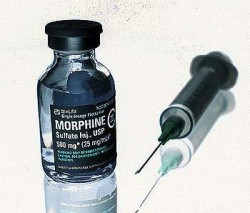
Morphine is a widely used legal type of opiate.
Opium contains five principle psychoactive alkaloids from which pharmaceutical opiate medicines are made. Morphine is most abundant and the others are codeine, thebaine, papaverine, and noscapine. All are controlled by the DEA along with their derivatives, semi-synthetic and synthetic substitutes under the Controlled Substances Act. Most are classified as schedule II substances having a legitimate medical purpose with a high potential for abuse and dependence. Heroin is an opiate, however, that has no acceptable medical purpose, no safety in use, and is totally illegal, classified as a schedule I substance under the CSA.
Common opiate medicines include morphine, codeine, oxycodone, hydrocodone, and a hundreds of different derivatives, combinations, and brands. Methadone and Fentanyl are examples of synthetic opiates that produce the narcotic effects while not being processed from any opium or its derivatives.
Opiate Effects
Opiates act as central nervous system depressants to reduce pain stimuli while producing a calming or euphoric effect. They also depress breathing and heart rate which can lead to overdose and death. Opiate abusers often experience the euphoria as the preferred effect, but, once addiction takes hold, there is an overwhelming need to consume higher amounts of the drugs leading to uncontrollable cravings and use, despite the adverse consequences; and withdrawals when the drugs become unavailable.
 How Do I Reconnect with Family During Opium Addiction Treatment? -
Opium addiction can be very difficult on the addicted individual, but it can also seriously hurt their family members, friends, and other loved ones. According to the National Institute on Drug Abuse, “Drug abuse puts a lot of stress on parents, brothers and sisters, grandparents––anyone who is part of the home,” and this often causes ...
How Do I Reconnect with Family During Opium Addiction Treatment? -
Opium addiction can be very difficult on the addicted individual, but it can also seriously hurt their family members, friends, and other loved ones. According to the National Institute on Drug Abuse, “Drug abuse puts a lot of stress on parents, brothers and sisters, grandparents––anyone who is part of the home,” and this often causes ...  Opioid Addiction: Why Professional Treatment is a Necessity -
The withdrawal symptoms of opioid drugs are widely known as being the worst to handle and most people who try to do it on their own will yield to the pain. These symptoms require professional help to overcome so that the addict can move closer to becoming sober. Addicts should know why professional treatment is ...
Opioid Addiction: Why Professional Treatment is a Necessity -
The withdrawal symptoms of opioid drugs are widely known as being the worst to handle and most people who try to do it on their own will yield to the pain. These symptoms require professional help to overcome so that the addict can move closer to becoming sober. Addicts should know why professional treatment is ...  Am I Addicted to Opiates or Am I Struggling with Physical Dependence? -
Whether you're battling physical dependence or a full-blown addiction to opiates, seeking professional treatment should be considered.
Am I Addicted to Opiates or Am I Struggling with Physical Dependence? -
Whether you're battling physical dependence or a full-blown addiction to opiates, seeking professional treatment should be considered.  Short Term Effects of Opium -
Opium is an analgesic drug that produces euphoric effects. The short term effects of opium use are mostly related to the euphoric feelings that come from smoking the drug. The user will feel sleepy, drowsy or relaxed similar to the feelings that come from alcohol. These short term effects will differ for each individual and ...
Short Term Effects of Opium -
Opium is an analgesic drug that produces euphoric effects. The short term effects of opium use are mostly related to the euphoric feelings that come from smoking the drug. The user will feel sleepy, drowsy or relaxed similar to the feelings that come from alcohol. These short term effects will differ for each individual and ...  Signs & Symptoms of Codeine Abuse -
Learn then numerous mood, behavioral, physical, and psychological symptoms of codeine abuse.
Signs & Symptoms of Codeine Abuse -
Learn then numerous mood, behavioral, physical, and psychological symptoms of codeine abuse.