Through ongoing research and development, the opium poppy plant has spawned an entire family of drugs, commonly known as opiates. The majority of opiates produce pain-relieving effects, though there are a handful that produce different types of effects.
According to Palomar College, the opium poppy contains several alkaloids, or organic compounds that can interact with the human body and alter more than a few of its essential chemical processes. The list of opiates derived from the opium poppy can be broken up into different drug classifications based on each drug’s relation to the opium poppy plant.
For information on opiate addiction treatment programs, call our toll-free helpline at 877-743-0081 (Who Answers?).
Opiate Drug Classifications
As a group, opiates interact with the body’s own pain-management system, which is made up of various neurotransmitter and endorphin chemicals. In turn, opiate or opioid receptor sites exist throughout the brain, spinal cord, digestive tract as well as in other organs throughout the body, according to the National Institute on Drug Abuse.
This list of opiates starts with the natural opium poppy alkaloids and then progresses into the man-made or synthetic varieties.
Natural Opium Derivatives
Natural opium-based drugs are derived from the alkaloid compounds found in the opium poppy plant. Natural derivatives include the following:
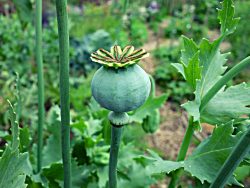
Natural opiates are derived from the opium poppy plant.
- Morphine
- Codeine
- Heroin
- Thebaine
- Oripavine
Morphine and heroin in particular exist as the two strongest natural opium derivatives. Morphine-based alkaloids appear in large concentrations within the opium poppy, whereas as heroin comes from specific types of opium poppy plants, such as the Asian poppy.
Semisynthetic Opium Derivatives
Semisynthetic opium derivatives contain both natural and synthetic, or man-made ingredients. This opiate classification contains a few of the more powerful prescription opiate drugs on the market.
Some of the more commonly used semisynthetic opiates include:
- Oxymorphone
- Oxycodone
- Hydromorphone
- Hydrocodone
- Buprenorphine
Since these drugs contain a mixture of natural and man-made ingredients, they can vary in potency levels based on any one drug’s synthetic chemical makeup.
Synthetic Opium Derivatives
Synthetic opium derivatives contain all man-made ingredients, with this classification including some of the most powerful prescription opiate drugs in existence. As opiates carry a high risk for abuse and addiction, the more powerful the drug the greater the risk, according to the Journal of Drug & Alcohol Dependence.
Some of the more well-known synthetic opiates include:
- Fentanyl
- Lortab
- Demerol
- Methadone
- Dilaudid
- Norco
- Atarax
Opiate Addiction Treatment Medications
This list of opiates contains a few choice drugs that have been specifically designed to treat opiate addiction. Both buprenorphine and methadone produce effects that work to stabilize chemical imbalances in the brain left behind by chronic opiate addiction.
Yet another classification to add to the list of opiates are the antagonist drugs. Naltrexone and naloxone, two drugs that work as opiate addiction preventative agents, produce uncomfortable effects in the event a person relapses in recovery.
Considerations
While this list of opiates is by no means exhaustive, it does cover the main categories for this group of drugs. It helps to keep in mind that regardless of whether a person uses opiates for treatment purposes or on a recreational basis, the abuse and addiction potential for opiates remains the same.
Please don’t hesitate to call our helpline at 877-743-0081 (Who Answers?) if you need help finding an opiate addiction treatment program.
 Opioid Addiction: Why Professional Treatment is a Necessity -
The withdrawal symptoms of opioid drugs are widely known as being the worst to handle and most people who try to do it on their own will yield to the pain. These symptoms require professional help to overcome so that the addict can move closer to becoming sober. Addicts should know why professional treatment is ...
Opioid Addiction: Why Professional Treatment is a Necessity -
The withdrawal symptoms of opioid drugs are widely known as being the worst to handle and most people who try to do it on their own will yield to the pain. These symptoms require professional help to overcome so that the addict can move closer to becoming sober. Addicts should know why professional treatment is ...  5 Signs You Need Opium Addiction Treatment -
1. Your Work and School Performance are Suffering. When someone becomes addicted to a drug, it will be all they want to do and all they care about. Many times, addiction to opium can make a person feel that their responsibilities like work and school are not as important. According to the DOI, “The apathy ...
5 Signs You Need Opium Addiction Treatment -
1. Your Work and School Performance are Suffering. When someone becomes addicted to a drug, it will be all they want to do and all they care about. Many times, addiction to opium can make a person feel that their responsibilities like work and school are not as important. According to the DOI, “The apathy ...  What’s Involved in Holistic Heroin Detox Treatment? -
Holistic heroin detox is a natural, effective way to overcome addiction for those opposed to using replacement medications.
What’s Involved in Holistic Heroin Detox Treatment? -
Holistic heroin detox is a natural, effective way to overcome addiction for those opposed to using replacement medications.  Long Term Effects of Oxycodone Abuse You Should be Aware Of -
Oxycodone is an opioid painkiller synthesized from the thebaine alkaloid of opium. Like other opium drugs, including heroin and morphine, oxycodone produces euphoria in high enough concentrations that is the primary reason it is abused. We’ve all heard the horror stories about the effects of long-term heroin abuse and in many ways, oxycodone is no ...
Long Term Effects of Oxycodone Abuse You Should be Aware Of -
Oxycodone is an opioid painkiller synthesized from the thebaine alkaloid of opium. Like other opium drugs, including heroin and morphine, oxycodone produces euphoria in high enough concentrations that is the primary reason it is abused. We’ve all heard the horror stories about the effects of long-term heroin abuse and in many ways, oxycodone is no ...  What are the Stages of Opiate Withdrawal? -
Opiates are those drugs including opium, opium derivatives, and the semi-synthetic or synthetic substitutes with similar chemical structures. The most common opiates are fentanyl, methadone, morphine, codeine, oxycodone, hydrocodone, and the illegal drug, heroin. No matter which opiate drug you use, repeated use can lead to dependency and subsequently, withdrawals upon ceasing. The stages of ...
What are the Stages of Opiate Withdrawal? -
Opiates are those drugs including opium, opium derivatives, and the semi-synthetic or synthetic substitutes with similar chemical structures. The most common opiates are fentanyl, methadone, morphine, codeine, oxycodone, hydrocodone, and the illegal drug, heroin. No matter which opiate drug you use, repeated use can lead to dependency and subsequently, withdrawals upon ceasing. The stages of ...